Here for beer or for code
  1. 0
    The world of software development is constantly evolving. New programming languages, frameworks, tools, and technologies emerge every year, making it increasingly important for developers to stay informed, learn from others, and build professional connect...

    vzb99r6u3tqnls2u2fey

    The world of software development is constantly evolving. New programming languages, frameworks, tools, and technologies emerge every year, making it increasingly important for developers to stay informed, learn from others, and build professional connections.

    While online courses, documentation, and technical blogs are valuable learning resources, developer communities offer something equally important: the opportunity to connect with people who face the same challenges, share practical experience, exchange ideas, and collaborate on projects.

    Whether you're a beginner learning your first programming language, an experienced software engineer, a freelancer, or an aspiring tech entrepreneur, joining the right developer communities can help you grow professionally and stay ahead of industry trends.

    In 2026, there are plenty of platforms where programmers can ask questions, showcase their work, discuss new technologies, discover career opportunities, and contribute to the global developer ecosystem.

    1. 3
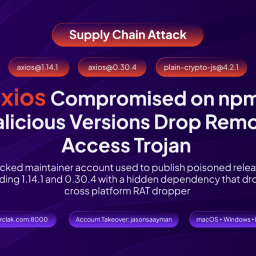
      A highly sophisticated supply chain attack has struck one of the most widely used JavaScript libraries in the world. Two malicious versions of the popular HTTP client axios—1.14.1 and 0.30.4—were published to npm after a maintainer account was hijac...

      A highly sophisticated supply chain attack has struck one of the most widely used JavaScript libraries in the world. Two malicious versions of the popular HTTP client axios—1.14.1 and 0.30.4—were published to npm after a maintainer account was hijacked, introducing a stealthy remote access trojan (RAT) affecting macOS, Windows, and Linux systems.

      With over 100 million weekly downloads, axios sits at the core of countless applications. This incident represents one of the most precise and operationally advanced attacks ever observed in the npm ecosystem.

      Immediate warning

      If you installed:

      Assume your system is compromised.

      How the attack worked

      1. Maintainer account hijack

      The attacker gained control of a primary axios maintainer’s npm account and used it to publish malicious versions directly to npm—bypassing the project’s secure GitHub Actions release pipeline.

      These releases:

      • Appeared legitimate (same maintainer identity)
      • Had no corresponding GitHub commits or tags
      • Were published using a stolen long-lived npm token (not secure OIDC publishing)

      2. Pre-staged malicious dependency

      The attacker quietly published a package named:

      [email protected]

      This package:

      • Mimicked a legitimate crypto library
      • Included no obvious malicious code in its main files
      • Contained a hidden postinstall script: “postinstall”: “node setup.js”

      This script executed automatically during installation—no import required.

      3. Dependency Injection into axios

      The compromised axios versions added a single new dependency:

      “plain-crypto-js”: “^4.2.1”

      That’s it.

      No other files changed. No malicious code inside axios itself.

      This is what made the attack so dangerous:

      • Static code inspection shows nothing suspicious
      • The payload executes during install, not runtime
      • The dependency is never actually used in the code

      The payload: Cross-platform RAT dropper

      Once triggered, the malicious dependency:

      1. Executes instantly during npm install
      2. Contacts a live command-and-control (C2) server
      3. Downloads a platform-specific second-stage payload
      4. Installs a remote access trojan
      5. Deletes itself and wipes evidence

      Read the entire article on the Hacking News post: https://www.hackingnews.com/malware/axios-compromi...

      1. 3
        Generative AI has transformed the way enterprises build, interact, and automate. But as adoption of large language models (LLMs) accelerates, so do the risks. From model manipulation to shadow usage, these systems introduce new and evolving threat v...

        Generative AI has transformed the way enterprises build, interact, and automate. But as adoption of large language models (LLMs) accelerates, so do the risks. From model manipulation to shadow usage, these systems introduce new and evolving threat vectors, many of which traditional security stacks fail to detect or mitigate effectively.

        At Typing AI Biometrics, we combine behavioral biometrics with advanced AI security tooling to help organizations secure every layer of generative AI. Below, we outline the top 10 risks facing LLM-powered apps in 2025 and how to reduce exposure while maintaining innovation velocity.

        1. Prompt Injection

        Risk: Attackers craft inputs designed to manipulate model behavior, override safety constraints, or leak context data. These inputs may come from users or third-party systems.


        Mitigation: Apply input validation and structure prompts using strict system/user separation. Monitor for anomalous patterns using behavioral AI. Deploy guardrails to detect and neutralize prompt manipulation before it reaches the model.

        2. Data leakage through outputs

        Risk: LLMs may expose internal data, personally identifiable information (PII), or confidential content unintentionally through completions.


        Mitigation: Implement output filtering and redaction. Use behavioral identity signals to limit access to context-sensitive operations. Enforce context lifespan policies and log access trails.

        3. Hallucinations

        Risk: LLMs often generate plausible but false information, leading to poor decisions or compliance breaches when outputs are trusted too readily.


        Mitigation: Integrate retrieval-augmented generation (RAG) with curated knowledge bases. Flag uncertain or unverifiable responses. Include human-in-the-loop (HITL) where business-critical accuracy is needed.

        Read the entire article on the Typing AI Biometrics blog: https://typing.ai/blog/2025-top-10-risks-and-mitig...


        1. 4
          IntroductionData Activity Monitoring (DAM) is a crucial component of modern data security and compliance strategies. It serves as a sentinel for organizations, safeguarding sensitive information against unauthorized access, breaches, or misuse. What...

          Introduction

          Data Activity Monitoring (DAM) is a crucial component of modern data security and compliance strategies. It serves as a sentinel for organizations, safeguarding sensitive information against unauthorized access, breaches, or misuse.

          What is Data Activity Monitoring?

          Data Activity Monitoring (DAM) is a proactive cybersecurity approach designed to track, monitor, and analyze the actions performed on an organization's data assets. By recording and analyzing data-related activities, DAM solutions provide real-time insights into potential threats and anomalies, giving security teams a chance to respond swiftly and prevent data breaches.

          Read the entire article on the Typing AI Biometrics blog: https://typing.ai/blog/the-essence-of-data-activit...

          1. 3
            Protectumus, as a cloud cyber security startup, recognizes the increasing importance of Environmental, Social, and Governance (ESG) factors in today's business landscape. ESG has emerged as a crucial framework for assessing a company's sustainability...

            Protectumus, as a cloud cyber security startup, recognizes the increasing importance of Environmental, Social, and Governance (ESG) factors in today's business landscape. ESG has emerged as a crucial framework for assessing a company's sustainability and ethical practices. We understand that integrating ESG considerations into our operations is not only responsible but also critical for long-term success.

            At Protectumus, we have taken several measures to address ESG concerns. First and foremost, we prioritize environmental sustainability by optimizing our infrastructure to minimize energy consumption and carbon footprint. We actively promote responsible use of resources within our organization and encourage our employees to adopt eco-friendly practices.

            Read the entire article on the Protectumus cyber security blog: https://protectumus.com/blog/details/recognizing-the-increasing-importance-of-environmental-social-governance-esg

            1. 3
              When moving to 2023, cyber security and threat detection will remain at the top of businesses. Data breaches have been a major concern for all small and large businesses.According to a report by IBM, the average data breach cost reached $4.35 billion in 2...

              When moving to 2023, cyber security and threat detection will remain at the top of businesses. Data breaches have been a major concern for all small and large businesses.

              According to a report by IBM, the average data breach cost reached $4.35 billion in 2022. Data breaches have increased by 2.6% than the previous year.

              Due to this, the emphasis on cyber-physical systems, data privacy laws, and ransomware attacks has increased tremendously. These audits have become the top priority of risk and security leaders.

              Read the entire article on Protectumus blog: https://protectumus.com/blog/details/cyber-securit...

              1. 3
                Traditionally we used Web Application Firewalls to protect the web apps. However, WAAP is the newer protection method that web apps are currently using that comes as an evolution of cloud web app firewall services. What is WAAP? Web apps are programs avai...

                Traditionally we used Web Application Firewalls to protect the web apps. However, WAAP is the newer protection method that web apps are currently using that comes as an evolution of cloud web app firewall services.

                What is WAAP?

                Web apps are programs available online, and any user can access them via the internet from any part of the world. Web apps have several features, some of which are integrated using APIs. WAAP safeguards the web apps and the APIs used in those apps together.

                WAAP comes as a service that provides auto-scaling security modules to your infrastructure and protects against several attacks. When getting WAAP services, users can also get additional services to enhance experience and performance.

                Read the entire article on the Protectumus cybser security blog, here: https://protectumus.com/blog/details/what-is-web-a...

                1. 3
                  Link shared • Programming Technology Hacking Cyber Security • 4 years ago
                  protectumus.com
                  BeerAndCode
                  Here for beer or for code
                  With the increasing number of digital threats, it has become necessary for search engines to determine the difference between legit websites and those that are not legit. The websites that are not legit can contain viruses and malware, but it is not effic...

                  ddxorwvebbytsukww3oe

                  With the increasing number of digital threats, it has become necessary for search engines to determine the difference between legit websites and those that are not legit. The websites that are not legit can contain viruses and malware, but it is not efficient that search engines to list all the websites that are found to have issues. It is where domain blacklisting comes in, and here, we will discuss everything you need to know about it.

                  What are Domain Blacklists, and how do they work?

                  A domain blacklist is a real-time database used by search engines to identify websites with malicious content. These websites are identified by their ISPs, and they are used as references to check if an email incoming from them is trustable or not using the email servers.

                  As a domain is found unsafe, it is moved to spam, and domain blacklisting is the same for websites over the internet. The main way of working is to find a trace of negative behavior; as soon as something negative is found, that domain is blacklisted.

                  Read the entire article on the Protectumus Website Security blog - https://protectumus.com/blog/details/what-is-domai...

                  1. 3
                    The trend of cyberattacks has grown a lot in the past few years, and with the increasing need for online systems, it may increase even more in coming years. So, every company must secure its systems against such attacks, and penetration testing is an effe...

                    The trend of cyberattacks has grown a lot in the past few years, and with the increasing need for online systems, it may increase even more in coming years. So, every company must secure its systems against such attacks, and penetration testing is an effective option.

                    Penetration testing (Pen-testing) tests your system by emulating cyber-attacks on the system, network and applications. Thus, you can see the vulnerabilities of your system. It can be automated or manual, but in either case, it shows the vulnerabilities of your IT infrastructure.

                    Why is Penetration Testing Important in Cyber Security?

                    With cyberattacks becoming more frequent, a cost-effective solution is required, and penetration testing makes a great option. Here are some reasons why it is important today..

                    Read the entire article on the cyber security software Protectumus blog: https://protectumus.com/blog/details/the-importanc...

                    1. 2
                      OTP stands for the one-time password or one-time passcode and is a form of multi factor authentication (MFA). Almost every website or application now supports the functionality of the OTP due to rising security concerns. When you create a new account on a...

                      OTP stands for the one-time password or one-time passcode and is a form of multi factor authentication (MFA). Almost every website or application now supports the functionality of the OTP due to rising security concerns. When you create a new account on a website or an application, or even if you are an existing user of any particular app, you can enable the OTP to protect the misuse of your data and identity theft.

                      Once enabled, the system then asks you to put in your email address or mobile phone, over which it sends a code each time you enter your login credentials. You then must enter that code alongside your credentials to successfully log into your account. If the OTP you received does not match the entered OTP, the system will give you an error, and you will not be able to log in successfully.

                      Read the entire article here: https://protectumus.com/blog/details/reasons-you-s...

                      0
                      followers
                      0
                      following
                      About
                      No information