1. 0
    The world of software development is constantly evolving. New programming languages, frameworks, tools, and technologies emerge every year, making it increasingly important for developers to stay informed, learn from others, and build professional connect...

    vzb99r6u3tqnls2u2fey

    The world of software development is constantly evolving. New programming languages, frameworks, tools, and technologies emerge every year, making it increasingly important for developers to stay informed, learn from others, and build professional connections.

    While online courses, documentation, and technical blogs are valuable learning resources, developer communities offer something equally important: the opportunity to connect with people who face the same challenges, share practical experience, exchange ideas, and collaborate on projects.

    Whether you're a beginner learning your first programming language, an experienced software engineer, a freelancer, or an aspiring tech entrepreneur, joining the right developer communities can help you grow professionally and stay ahead of industry trends.

    In 2026, there are plenty of platforms where programmers can ask questions, showcase their work, discuss new technologies, discover career opportunities, and contribute to the global developer ecosystem.

    1. 1
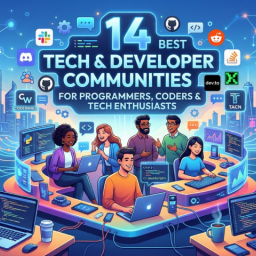
      Software development is about more than writing code. It involves learning new technologies, solving challenging problems, sharing knowledge, discovering tools, meeting like-minded people, and keeping up with an industry that changes constantly.Developer...

      Software development is about more than writing code. It involves learning new technologies, solving challenging problems, sharing knowledge, discovering tools, meeting like-minded people, and keeping up with an industry that changes constantly.

      Developer communities make all of this easier. They bring together software engineers, programmers, web developers, open-source contributors, startup founders, designers, and technology enthusiasts who want to learn from one another and exchange ideas.

      Whether you're a beginner looking for programming help, an experienced developer exploring new technologies, or an indie founder building your next product, joining the right communities can help you grow professionally and discover opportunities you might otherwise miss.

      But not every community serves the same purpose. Some focus on technical questions and answers, while others specialize in industry news, developer blogging, product launches, or startup growth.


      Read the entire article in The Startup Network

      1. 2
        The Coderwall team is pleased to announce the relaunch of Coderwall Dev Community, featuring several improvements designed to enhance the user experience and make discovering developer content easier.What’s new:Faster website loadingImproved navigation an...

        kjlik0a8pafmdhdqesnl

        The Coderwall team is pleased to announce the relaunch of Coderwall Dev Community, featuring several improvements designed to enhance the user experience and make discovering developer content easier.

        What’s new:

        • Faster website loading
        • Improved navigation and user experience
        • Site-wide search functionality
        • Light and dark mode support
        • Responsive design across devices
        • Ability to follow programming topics and users
        • Options to filter new, popular and trending content based on the topics and users you follow
        • Ability to easily search and discover trending tech and code topics
        • Ability to see programming topics grouped into categories
        • Ability to discover software products and rate them

        Explore the updated platform and discover a better way to stay connected with the Coderwall developer community.

        1. 3
          A highly sophisticated supply chain attack has struck one of the most widely used JavaScript libraries in the world. Two malicious versions of the popular HTTP client axios—1.14.1 and 0.30.4—were published to npm after a maintainer account was hijac...

          A highly sophisticated supply chain attack has struck one of the most widely used JavaScript libraries in the world. Two malicious versions of the popular HTTP client axios—1.14.1 and 0.30.4—were published to npm after a maintainer account was hijacked, introducing a stealthy remote access trojan (RAT) affecting macOS, Windows, and Linux systems.

          With over 100 million weekly downloads, axios sits at the core of countless applications. This incident represents one of the most precise and operationally advanced attacks ever observed in the npm ecosystem.

          Immediate warning

          If you installed:

          Assume your system is compromised.

          How the attack worked

          1. Maintainer account hijack

          The attacker gained control of a primary axios maintainer’s npm account and used it to publish malicious versions directly to npm—bypassing the project’s secure GitHub Actions release pipeline.

          These releases:

          • Appeared legitimate (same maintainer identity)
          • Had no corresponding GitHub commits or tags
          • Were published using a stolen long-lived npm token (not secure OIDC publishing)

          2. Pre-staged malicious dependency

          The attacker quietly published a package named:

          [email protected]

          This package:

          • Mimicked a legitimate crypto library
          • Included no obvious malicious code in its main files
          • Contained a hidden postinstall script: “postinstall”: “node setup.js”

          This script executed automatically during installation—no import required.

          3. Dependency Injection into axios

          The compromised axios versions added a single new dependency:

          “plain-crypto-js”: “^4.2.1”

          That’s it.

          No other files changed. No malicious code inside axios itself.

          This is what made the attack so dangerous:

          • Static code inspection shows nothing suspicious
          • The payload executes during install, not runtime
          • The dependency is never actually used in the code

          The payload: Cross-platform RAT dropper

          Once triggered, the malicious dependency:

          1. Executes instantly during npm install
          2. Contacts a live command-and-control (C2) server
          3. Downloads a platform-specific second-stage payload
          4. Installs a remote access trojan
          5. Deletes itself and wipes evidence

          Read the entire article on the Hacking News post: https://www.hackingnews.com/malware/axios-compromi...

          1. 2
            Anthropic appears to have accidentally shipped a .map file with their Claude Code npm package, exposing the full readable source of the CLI tool. The package has since been pulled, but not before it was widely mirrored and dissected.A few interestin...

            Anthropic appears to have accidentally shipped a .map file with their Claude Code npm package, exposing the full readable source of the CLI tool. The package has since been pulled, but not before it was widely mirrored and dissected.

            A few interesting findings from the leaked code:

            • Anti-distillation mechanisms:
              The client can request “fake tool” injection to poison training data for anyone scraping API traffic. There’s also a system that summarizes intermediate outputs with signed blobs, so recorded traffic doesn’t contain full reasoning chains. Both mechanisms are feature-flagged and relatively easy to bypass.
            • “Undercover mode”:
              A built-in mode prevents the model from revealing internal codenames or even mentioning “Claude Code.” Notably, it cannot be force-disabled in external contexts, meaning AI-generated contributions may intentionally appear human-authored.
            • Frustration detection via regex:
              Instead of using an LLM, user frustration is detected with a simple regex matching phrases like “wtf,” “this sucks,” etc. Cheap and fast, if a bit ironic.
            • Client attestation at the transport layer:
              Requests include a placeholder that gets replaced with a hash by Bun’s native HTTP stack (in Zig), allowing the server to verify requests come from an official binary. This acts like lightweight DRM for API access, though it’s gated behind flags and not airtight.
            • Operational inefficiency:
              A comment notes ~250K API calls/day were being wasted due to repeated failures in a compaction routine. Fixed by adding a simple failure cap.
            • KAIROS (unreleased):
              The code references a heavily gated autonomous agent mode with background workers, scheduled tasks, memory distillation, and GitHub integration—suggesting an always-on agent system in development.
            1. 4
              As 2024 draws to a close, Typing AI Biometrics reflects on a year filled with innovation, collaboration, and major milestones. From groundbreaking partnerships to cutting-edge product launches, the company has strengthened its position as a leader i...

              As 2024 draws to a close, Typing AI Biometrics reflects on a year filled with innovation, collaboration, and major milestones. From groundbreaking partnerships to cutting-edge product launches, the company has strengthened its position as a leader in AI and biometric authentication.

              1. Second year in the Google AI Startup Program - Scale Tier

              In its second year as part of the prestigious Google AI Startup Program - Scale Tier, Typing AI Biometrics capitalized on the resources and support provided by Google. Key benefits included:

              • Substantial cloud credits: The program offered up to $350,000 USD in Google Cloud and Firebase usage credits over two years. In the first year, credits totaled $250,000 USD, with 100% of Google Cloud expenses covered, including an additional $150,000 USD exclusively for AI startups. In the second year, 20% coverage of up to $100,000 USD was provided.
              • Enhanced support: The company received $12,000 USD in Google Cloud Enhanced Support credits, ensuring access to expert technical assistance.
              • Workspace productivity: Free access to Google Workspace Business Plus for 12 months streamlined communication and collaboration within the company.

              These resources empowered Typing AI Biometrics to develop advanced cloud-based biometric solutions and enhance its operational efficiency.

              2. Joining the MongoDB for Startups Program

              In January 2024, Typing AI Biometrics joined the MongoDB for Startups program, further strengthening its technological infrastructure. Key benefits included:

              • Database credits: $500 in MongoDB Atlas credits, with the potential for an additional $4,500 at the end of the first 12 months.
              • Expert collaboration: Access to MongoDB experts for fast-tracked support, strategic partnerships, and joint go-to-market opportunities.
              • Showcasing innovation: A platform to highlight Typing AI Biometrics’ AI solutions to MongoDB’s extensive user base, customers, and partners.

              This partnership played a pivotal role in optimizing the company’s database operations, supporting its mission to revolutionize biometric authentication through AI-driven innovation.

              3. Strategic Partnership with Kartaca

              In June, Typing AI Biometrics announced a strategic collaboration with Kartaca, a technology consulting firm specializing in Google Cloud services. This partnership enabled Typing AI Biometrics to leverage Google's state-of-the-art AI tools, including:

              • Gemini AI: For advanced natural language understanding and generative tasks.
              • DialogFlow: To enhance conversational agents and streamline user interactions.
              • Document AI: For automated document processing and data extraction.
              • Vertex AI: To efficiently build, deploy, and scale machine learning models.

              Read the entire article on the Typing AI blog: https://typing.ai/blog/typing-ai-biometrics-2024-y...

              1. 2
                Cybersecurity threats changing quickly. More people working remotely. Businesses need digital identity verification solutions more than ever to use cloud services, and making online transactions. These solutions help confirm customer identities and kee...

                Cybersecurity threats changing quickly. More people working remotely. Businesses need digital identity verification solutions more than ever to use cloud services, and making online transactions. These solutions help confirm customer identities and keep sensitive information safe from unauthorized access.

                New technologies like artificial intelligence, biometrics, and passwordless authentication are making security stronger. These advancements help businesses deal with ongoing cybersecurity challenges and build trust with their customers.

                Importance of User Authentication

                Good user authentication methods keep sensitive information safe and stop unauthorized access. It helps prevent identity theft and impersonation by verifying who users are. It ultimately helps in ensuring only the real owner can access their accounts.

                Also, many industries have strict rules about data protection and privacy. Using strong authentication methods helps you follow these rules. It can keep you out of legal trouble and help you avoid fines.

                Read the entire article on the Is it hacked blog: https://isithacked.com/blog/top-authentication-tre...

                1. 3
                  OWASP is a non-profit foundation focused on web application security. It offers freely accessible resources like forums, tools, videos, and documentation on their website. Their notable projects include the OWASP Top 10. It highlights web app securi...

                  OWASP is a non-profit foundation focused on web application security. It offers freely accessible resources like forums, tools, videos, and documentation on their website. Their notable projects include the OWASP Top 10. It highlights web app security concerns. The OWASP API Security Top 10 identifies prevalent API security risks.

                  An Overview of Top 10 2024 OWASP API Security Risks

                  1) BOLA

                  Broken Object Level Authorization represents a critical vulnerability that comes from the failure to validate permissions of a user to execute a specific action on an object. It can potentially result in the unauthorized access, modification, or deletion of data.

                  According to OWASP this API security threat is widespread and exploitable. It is moderate in its business aspect and can be detected as well.

                  • It is essential to implement a robust authorization mechanism to mitigate this vulnerability.
                  • Developers should conduct thorough checks to validate actions of a user on individual records.

                  They should also perform comprehensive security tests prior to implementing any changes in a production environment. Organizations can significantly reduce the risk of BOLA vulnerabilities and safeguard sensitive data from unauthorized access and manipulation by following to these precautions.

                  2) Broken Authorization

                  This API security risk represents a significant security vulnerability that arises when an application's authentication endpoints are unable to identify attackers who are posing as someone else and subsequently grant them partial or complete access to the account.

                  It is crucial to have visibility and understanding of all potential authentication API endpoints to mitigate this vulnerability.


                  Read the entire article on the Typing AI Biometrics blog: https://typing.ai/blog/introduction-to-owasp-api-security-top-10-2024

                  1. 3
                    Are you a startup looking to join one of the most serious, intensive and helpful Startups Accelerator Program? We recommend the Fil Rouge Capital #FRCW24 program. Applications are now open!Going Beyond the OrdinaryAt Fil Rouge Capital, the accelerator p...

                    Are you a startup looking to join one of the most serious, intensive and helpful Startups Accelerator Program? We recommend the Fil Rouge Capital #FRCW24 program. Applications are now open!

                    Going Beyond the Ordinary

                    At Fil Rouge Capital, the accelerator program offers more than just financial support. Selected startups are promised a treasure trove of value that extends beyond monetary benefits. The post highlights a myriad of perks awaiting successful applicants from tech giants such as Amazon, Microsoft, and more, emphasizing the limitless possibilities that come with being a part of the FRC community.

                    What's in Store for Applicants?

                    The post outlines the enticing offerings awaiting successful applicants:

                    • Financial Support: Applicants have the right, though not an obligation, to invest a minimum of EUR 50,000 from FRC's next investment fund, with the potential for further follow-up investments from FRC and its co-investors.
                    • Mentorship: Full access to the extensive FRC mentor network, providing valuable guidance and support.
                    • Dedicated Lead Mentor: Each selected startup will have a dedicated Lead mentor from Fil Rouge Capital's esteemed principals, ensuring personalized guidance throughout the program.
                    • Educational Opportunities: Access to exclusive seminars led by industry experts to enhance knowledge and skills.
                    • In-House Perks: A variety of in-house perks designed to elevate startups during the program.

                    #startups #startup #eustartups #eustartp #VC #FilRougeCapital #FRC #startupsuccess #startupsineurope #capitalforthebold #boldstartups

                    https://www.linkedin.com/posts/fil-rouge-capital_f...

                    1. 2
                      The digital world has become more interconnected and dynamic than ever. However, the innovations in websites have also led to increased cyber vulnerabilities. About 30,000 sites get hacked daily.Well, the statistics are quite scary, but you can still prot...

                      The digital world has become more interconnected and dynamic than ever. However, the innovations in websites have also led to increased cyber vulnerabilities. About 30,000 sites get hacked daily.

                      Well, the statistics are quite scary, but you can still protect yourself by considering the right website security practices. This comprehensive guide will certainly help you to learn about the present website security threats state with different ways to protect your site from these security threats.

                      The current state of security threats for websites today

                      Here is a quick overview of websites’ security threats state at present:

                      • Phishing attacks remain one of the most prevalent and effective methods used by cybercriminals. Attackers usually impersonate legitimate identities through emails, SMS, or even social media to trick users into sharing sensitive information, like login credentials or financial data.
                      • Ransomware attacks have become increasingly common and devastating. Once a website is infected, the attacker encrypts critical files and demands a ransom in exchange for the decryption key.
                      • Cross-site scripting attacks use vulnerabilities in code of your site. It allows security attackers to inject infected scripts into your web pages that users view. These scripts can steal sensitive information or even hijack user sessions.
                      • ..

                      Read the entire article in the Protectumus blog page: https://protectumus.com/blog/details/how-to-protect-your-website-from-security-threats-in-2024

                      77
                      threads
                      2
                      followers
                      About This Board
                      Programming is the process of taking an algorithm and encoding it into a notation, a programming language, so that it can be executed by a computer. Although many programming languages and many different types of computers exist, the important first step...
                      Programming is the process of taking an algorithm and encoding it into a notation, a programming language, so that it can be executed by a computer. Although many programming languages and many different types of computers exist, the important first step is the need to have the solution.